Sunday, July 22, 2012
Retro/Modern Review: The Dark Knight Trilogy
Ah, Batman. Besides Superman, you're easily the longest running comic book film franchise in cinematic history. How many actors have played you now? How many fans have endlessly debated which version of you is the best? The Animated Series is the best television show, I know that much. The Arkham Games are the best video games, that is also certain. But the films are much trickier. While I do have a soft spot for the two Burton films and the first Schumacher film (what can I say, I'm in love with Jim Carrey's Riddler) the best Batman in film is obviously the Chris Nolan trilogy. Now that The Dark Knight Rises is out, and I have seen it three times (being the obsessive fanboy that I am) I have decided that instead of doing just a review of the third film, it would be better to review all three films as one, in order to point out the themes and motifs that run through the films and how they all sync up in order to form one big story.
Batman Begins is a great way to start the trilogy, and is easily one of the best, if not the best, superhero origin stories in modern cinema. Chris Nolan did a fantastic job in making Batman come off as real, and making all of his gadgets plausible. Using fear as a motif was brilliant, in that it reverberates in everything from Bruce's origin to his motivation to become Batman to the plans of the villains. Speaking of which, Cillian Murphy and Liam Neeson steal their scenes as Scarecrow and Ra's Al Ghul. Christian Bale is fantastic as both Bruce and Batman, and carries the pain of his parent's death on his shoulders magnificently.
The supporting cast is great too, with Morgan Freeman, Michael Caine, Gary Oldman, and Katie Holmes all delivering excellent performances as Fox, Alfred, Gordon, and Rachael Dawes, respectively. If there are any complaints with the film, it's that the latter half isn't as engaging as the first, with the scenes of Bruce Wayne in the mountains learning to be Batman easily more interesting than when he actually becomes the Caped Crusader (as awesome as it is when he does).
And then there's The Dark Knight. Wow. For a long time, I proclaimed this as my favorite superhero film, which is ironic considering it doesn't play out like how a hero film normally does. It feels a lot more like a crime drama than a superhero story, even if the main character does dress up like a giant bat. As teased at the end of the first film, The Dark Knight deals principally with the theme of escalation, with Batman's presence in Gotham bringing in The Joker and ultimately corrupting Harvey Dent into Two-Face. Joker and Two-Face are among my favorite Batman villains, and the way they are portrayed here is simply amazing. Aaron Eckhart's fall from grace is not only convincing but tragic to watch, and I actually felt for the guy.
As for Joker, what is there to say that millions haven't already? Heath Ledger steals every scene he's in, period. I've probably memorized every line of dialogue he utters, and I can't help but root for him knowing full well he's the villain. He's the perfect antithesis to Bale's Batman, and I love his portrayal. Posthumous or not, he deserved that Oscar, and while his death was tragic, at least his performance has truly immortalized him. If there are any flaws with this film, it's that the beginning, for me, doesn't match the mesmerizing twists and tuns of the end. As awesome as the Joker robbing the bank was, as was the scene in Hong Kong, the film doesn't really get going until the big chase scene between Bats and Joker. Everything after that is a treat to watch. Batman flipping over the truck, his interrogation of the Joker, Harvey becoming Two-Face, Batman's fugitive status at the end, all of it is so captivating I can't pull my eyes away whenever I watch it. How in hell could Nolan ever follow this up with something just as good?
I"m glad to say that he did. The Dark Knight Rises heralds the unthinkable: a perfect film trilogy. Not only does this film break the dreaded "third movie curse" that plagues so many film franchises, it actually emerges, I think, as the best of the three Nolan Batman films simply due to its story. And boy, is there a lot of story. Thankfully, unlike films such as the third Spider-Man and X-Men that suffer due to too many plots and characters, Nolan has a better understanding of how to make them all gel together into a cohesive whole. Every character gets their due, and while the resulting run time gets to nearly three hours, the pacing never makes the film feel boring.
As with its predecessors, Christian Bale, Michael Caine, Morgan Freeman, and Gary Oldman all deliver stellar performances here. However, I must give significant praise to Caine, who does so much with a role that is radically reduced this time out. His performance is so tearful and heartfelt, and his scenes with Bale really illustrate just how much Alfred cares for Bruce. Bale also gives his best performance out of the three, delivering a Bruce Wayne who's become a recluse after eight long years and is haunted not only by Rachel's death, but how all he accomplished for Gotham was based on a lie.
And then there's the newcomers, including Tom Hardy as Bane and Anne Hathaway as Catwoman. These two actors completely encapsulate the Bane and Catwoman of the comics, and come off as fully realized characters who own every scene they're in, even if their personalities aren't as magnetic as Ledger's Joker. Hardy's Bane is an extreme terrorist, who conveys malevolence and brute force with every step he takes. He is a more than capable threat for Batman, and the fact that Hardy can convey so much emotion when his face is covered by a mask speaks volumes of his ability to portray this monster of a villain.
Hathaway is the Catwoman of the comics, period. She's smart, sexy, and is a perfect match for Bale's Batman. She brings some much needed humor to the proceedings, and just like the comics has her own moral code that makes her walk both sides of the law. She occupies the gray area throughout the film, and Hathaway does such a great job at conveying that moral ambiguity that I'd even go so far as to say she's the definitive live action Catwoman.
But they're not the only newcomers to Nolan's Batman universe. Marion Cotillard and Joseph Gordon Levitt are also introduced as Miranda Tate and John Blake, respectively, although the latter half reveals them to be characters fans have been clamoring for in these films for a long time. The revelations of their true identities are expertly staged and come off as shocking twists, even if some fans won't find it surprising. They are (spoiler alert) Talia Al Ghul and Robin, who play major roles in the film when, towards the end, it becomes obvious they are meant to carry on the legacies of Ra's Al Ghul and Batman.
The name "Robin" is only referenced; Blake never wears a costume, although he does inherit the Batcave towards the end. Still, his role as a police officer is great here, as he establishes himself as a true hero in his own right who believes in the Batman and sets himself up as the logical successor to Bruce Wayne. As for Cotillard, her Miranda Tate facade is fairly uninteresting, and it is only the twist that she's Talia at the end that makes her character more intriguing. Out of all the characters, she's the only one who doesn't feel fully developed until the big twist at the end, probably because so much is going on that we don't have time to focus on her.
Like I previously mentioned, this film is filled with a huge amount of story. Thankfully, Nolan has such talent for presenting even the most convoluted stories in a logical fashion that the film never feels confusing. What I found really impressing, however, is how the story manages to wrap up the loose threads of the first two films and carry those previous themes and motifs to their logical conclusions. Escalation is continued in the form of Bane, who threatens to nuke Gotham and isolates it from the outside world, priming its citizens for urban warfare against Bane's army of criminals. The lie that Bruce and Gordon made to make Gotham a better place is upended as well, with all the characters dealing with the aftereffects of learning the truth behind Harvey Dent's corruption and Rachel's choice to be with him.
The motif of fear that drove Bruce to become Batman is, at the start of the film, nonexistent within Bruce. He welcomes death, and so when he becomes Batman again he is unprepared for Bane's ferocity. When Bane, in a moment of pure comic book geekiness, breaks Batman's back and stuffs him in an ancient prison, Bruce has reached the lowest point in his life. He is forced to learn, all over again, about the fear that drove him all those years ago, and by re-learning that fear gains the motivation to truly become Batman again, rising from the hellish pit of the prison and returning to Gotham to save it. Quite literally, "The Dark Knight Rises".
All of these themes come together really well to give the saga of Bruce Wayne a proper conclusion, even though the story of Batman, as teased with Levitt's character, has yet to end. As teased in the previous film, Bruce secretly wishes for a normal life beyond Batman, and becomes a recluse in this film because he couldn't move on after Rachel's death. With the introduction of Catwoman, Bruce finds a woman who's a perfect match for him, and at the end he finds peace when he and Catwoman leave to seek a new life together. What's more, he finally becomes the hero that Gotham needs, in that he apparently sacrifices himself to save Gotham from Bane and Talia's nuclear bomb. All of the themes are, by the end, reinforced and played out, culminating in an emotional finale that ends the trilogy on a high note.
The actions of Bruce, as well as the characters around him, point to one indisputable fact: by now, Batman has become, as Ra's Al Ghul told Bruce when they first met, "more than just a man. A legend." Now that Batman has risen from the pit, he fulfills the heroic archetype set forth by Joseph Campbell's monomyth, reinforcing the idea that Batman is a modern myth or legend for our time and signifying that even in this modern day and age, we still have a need for heroes. If any new theme or motif were to be introduced in this film, it would be "hope". Hope that we won't give in to evil and corruption, even after a horrific truth is revealed to us, and hope that anyone can rise to greatness after sinking into the depths of despair. In another brilliant way that the new film echoes its origins, Bruce falls so he can learn to pick himself up.
Nolan achieved what some say is unacheivable: he pulled off a perfect film trilogy. And how did he do it? Simply, he realized that each sequel has to serve as a natural extension of what came before, so that the three films together coalesce into one big story. The Dark Knight Rises is proof that he understands that, and the way he executed everything, from the story to the characters to the editing to the action (once again amazing as in its predecessors), only further illustrates his genius in bringing what is the first wholly perfect comic book film franchise to the silver screen. Batman is destined to live beyond this trilogy, whether as a continuation or a reboot. But whatever form he takes the next time he graces the cinema, this standalone trilogy by Chris Nolan has cemented itself as one of the best interpretations of the character outside of comics, and with this amazing ending in place, we now have a complete story that will live on for generations to come.
Monday, July 16, 2012
Retro Review: The Spider-Man Film Series
Since the release of "The Amazing Spider-Man" two weeks ago, I have seen the film a grand total of three times, no doubt due to my massive obsession with the character. This is an obsession I have nursed since I saw "Spider-Man 2" back in '04, the film that served as the catalyst for my love of Spider-Man and superheroes in general. I've made it pretty clear in articles past that I have a deep love for the Sam Raimi trilogy for this reason, but after seeing "Amazing" a couple times, I'm beginning to wonder how it actually compares to the originals. I said in my "Amazing" review that I would analyze the film on its own merits without actively comparing it to the old films. With this article, I intend to do nothing but comparing. I plan on looking back at the original three "Spider-Man" films, what I thought of them then and what I think of them now, and how they stack up compared to the new film. Let us begin.
The first Spider-Man film is still, in my mind, one of the best superhero films out there. The storyline is simple but effective, the cast is excellent, the action fantastic, and there is something awe inspiring about seeing Spider-Man come to life on screen for the first time. Tobey Maguire is very likable as Peter Parker, and manages to convey the shyness that pervades the character as well as his intelligence and awkwardness.
The rest of the cast, from Kirsten Dunst's Mary Jane and James Franco's Harry Osborn, to Rosemarry Harris's Aunt May and Cliff Robertson's Uncle Ben, all do a magnificent job of bringing Peter's friends and family to life. However, performance wise I must give significant praise to Willem Dafoe's Norman Osborn/Green Goblin and J.K. Simmons' J. Jonah Jameson. Simmons is a standout, both in this film and its two sequels, and brings an enormous amount of humor to the film. Dafoe's Green Goblin makes for a credible antagonist, delivering an over the top performance that is nonetheless threatening.
While the cast may shine, there are some aspects of the film that seem extremely dated after only ten years. The action, while still effective, suffers from CGI that doesn't quite hold up now as it did back then. The citizens of New York seem too overtly friendly, but then again this was released in the immediate aftermath of 9/11, so I guess I can let that slide. And then, of course, there's the Green Goblin suit. While I love what Dafoe brought to the character, the look of the Goblin is probably the biggest detriment to the film. Dafoe may come off as scary, but the costume does not. When Spidey and the Goblin fight, it feels like something from a Saturday morning cartoon. In a time when hero/villain battles are becoming increasingly more sophisticated on film, these battles seem rather childish by comparison.
However, as a piece of nostalgia, the film still works, not to mention it still does a fantastic job of portraying the origin of Spider-Man and, by the end, is just as effective as a standalone film as it is setting up for its sequels. Fans waited forty years to see this iconic hero brought to life, and for the first film ever to feature the character, it does a more than capable job of introducing him to new generations while remaining true to what makes him so appealing in the first place.
I am in love with this film. Even eight years after seeing it for the first time, this film still largely holds up and is easily the best of the Raimi trilogy. All the major cast members return and give more layered performances, while the plot goes deeper into the mythos and serves as a logical extension of the plot threads left dangling in the first film. In terms of the villain, Alfred Molina's Doctor Octopus is a much better antagonist than the Green Goblin. Not only is Molina pitch perfect as Doc Ock, visually he is much more threatening than the silly look of the Goblin. He gives the film a tangible threat, and the battles between him and Spidey are the highlights not only of the film, but of the entire trilogy. They still hold up almost a decade later.
That is not to say it's completely perfect, or devoid of criticism. Mary Jane's fiance, John Jameson, has no real personality or character to him, which is puzzling considering his father is by far the trilogy's most memorable character. The romance could be developed better, since Peter's insistence on staying away from MJ plays out as being too angsty. That said, Peter's motivations for quitting Spider-Man and resuming the mantle are excellent, and all around the film is near flawless. Maybe it's nostalgia talking, but I honestly can't find a lot to complain about this film. It still holds up for me whenever I watch it, and I get completely sucked in to the problems facing these characters. This is one of those rare examples in cinema where the sequel is actually better than the original. It improves on its predecessor in every way, and I couldn't enjoy it more.
I have very mixed feelings when it comes to this film. It is certainly the weakest of the Raimi films; that much is certain. However, there is a dedicated fanbase online who claims that this movie is the next Batman and Robin. While there are scenes and plot elements that certainly support this claim, even after seeing it again I can't say I hate this film the same way I hate that aforementioned stain on the Batman legacy.
The problems plaguing the film definitely stem from having too many plot threads going on at once. While the last two films were building to a confrontation between Peter and Harry, this movie shoves it to the sidelines to make room for new plots involving Sandman and Venom, who frankly are underdeveloped and don't come off as worthy antagonists, even though they both look fantastic. Venom in particular gets the shaft, with the symbiote storyline thrown in haphazardly and ultimately made a mockery of with the little song and dance number midway through the film, not only ruining Venom but making Peter into the world's biggest jackass as well. Giving the most popular Spider-Man villain fifteen minutes of screen time comes off as glorified fanservice, and ruins what could have been potentially the best story arc to run through the Spider-Man films.
The excuse to put Sandman into the movie completely rewrites the perfectly fine origin set up for Spidey in the first film, and as a result the villain Raimi obviously cared about the most comes off as more of a victim for Spidey to use as a punching bag than a legitimate threat to worry about. Harry's storyline is not given the justice it deserves, with Harry going from villain to best friend back and forth multiple times without any sense of conviction, not to mention his motivation towards the end is the result of another pointless retcon of the first film.
Not only do the villain storylines fall flat, but the romance between Peter and MJ that was so poignant the first two times plays more like a bad soap opera here. The chemistry between the leads is gone, replaced with excessive whining and a sense of tiredness between the actors. Multiple times did I ask myself: "are these two really in love? Is MJ really so perfect Peter would risk his life three consecutive times to save her?" The introduction of the Stacys feels pointless, as neither Gwen or her father are given much to do and we never get to really know them as characters.
When I first saw this film in theaters I loved it, but multiple viewings really exposed the flaws to me. So when reviewing a film like this, knowing full well it has a lot of things going against it, I have to ask myself is there anything good about it? What redeems this film in my eyes? Well, while Sandman and Venom may not have been done right as characters, their origin sequences are still fantastic, not only as CGI showcases but the only real insights we get into them as characters. I understand Eddie Brock's shame at being humiliated in the church, and when the symbiote envelopes him the transformation feels real: instantly he feels a rush in power and embraces the chance for vengeance.
Sandman's transformation, on the other hand, highlights the differences between him and Venom in that he doesn't want this power, but after seeing the monster he becomes decides to use it for the sake of his daughter. It's a beautiful sequence that I love watching. In addition, the action scenes are still breathtakilng, and J.K. Simmons' Jameson is still hilarious to watch. Overall, I'd say that the film has a couple amazing moments, but ultimately it's let down by the fact that it consists of moments only, and unlike the last two doesn't work as a cohesive whole due to all the plot points running around. The amount of story in this film alone had the potential for two movies, but Raimi's and the studio's insistence that all the plots be shoved into one film to give the series closure doomed it to mediocrity. It has enough moments that make me see the potential it had, but ultimately I can't call it a good film. Not terrible, not the worst ever, but not up to the level of the first two, and a definite disappointment. No wonder Sony decided to reboot after the film's reception. Speaking of which...
I already posted my review of this film, so there's no need to go into detail about what I thought about the story, the action, or the characters. There is, however, a need to finally talk about how this film compares to the original trilogy, and whether or not I think it's better, worse, or simply just as good acting as an alternative interpretation of the character.
In a lot of ways, "Amazing" is a vast improvement over its predecessors. Webb may not have the love and passion for Spider-Man that Sam Raimi had, but he certainly knows how to find the raw emotion that drives the Spider-Man mythos. Andrew Garfield is an infinitely better Peter Parker and Spider-Man than Tobey Maguire, since he captures the intelligence and humor of the character better than Maguire did. The Stacys feel like actual characters this time around, as opposed to SM3, and Gwen has infinitely better chemistry with Garfield than Maguire did with Dunst, not to mention Gwen actually contributes to helping defeat the Lizard instead of acting as a hostage. The Lizard, speaking of which, is a worthy antagonist. While I still think Doc Ock is the best film villain for the strength of his performance and character arc, Lizard was both visually intimidating and a great sympathetic character, so I would put him just above Goblin in terms of his effectiveness as a villain.
However, the comparison I think is most important is how effective is this film as an origin compared to the original. Is this, ultimately, a better character arc for Peter than the first movie? I think so. While the first film adapted the origin from the comics exactly, the new film has Peter learn the importance of responsibility through direct action, instead of feeling guilty for failing to stop his uncle's killer. New Peter still lets the killer get away, but instead of wallowing in grief and immediately using his powers selflessly, he goes on a revenge spree until the bridge incident, which forces him to realize he needs to be more responsible with his gifts. New Peter initially thinks he can honor his uncle by taking in the guy who killed him, but comes to realize it's better to embody his ideals on responsibility. The same story arc, only told with more emotional resonance and realism. I felt like New Peter went on a better journey and experienced more growth than the old Peter did, and for that reason I realize that this film is better than the first film as an origin tale.
Now don't get me wrong: I still love the old films, and the origin from the first film is still well told. However, the new origin seems more realistic from a contemporary point of view, and portrays a Peter that is not only more likable but struggles with real world problems. We get a better sense as to why an ordinary teenager would devote his life to superheroism. The first film was good as an introduction to the Spider-Man character and selling the epic grandeur of his world, but the new film is better at exploring relationships and experiences between characters. In my mind, it is better than the first and third films, and just as good as Spider-Man 2. The original trilogy was good for its time, and while some might consider the reboot premature, I am fully on board with this new iteration of Peter Parker. Compared to the first three, the new film is a worthy entry in the Spider-Man series that is deserving of carrying on the original trilogy's legacy. It is ready to tell a new story with an old character, one that may outshine the originals but doesn't negate the impact of what came before, or the significance.
Saturday, July 7, 2012
The Amazing Spider-Man review
I'm going to be frank: this is a very difficult film to review for me. Words cannot describe how much Spider-Man means to me as a character. I remember, eight years ago, when I sat down in a dark theater and watched Spider-Man 2 for the first time. That was my first superhero movie. The film that got me not only into the Spider-Man mythos, but into the world of comic books in general. I owe the entire Raimi trilogy a huge debt, for they set a standard for me by which I compared all other superhero films until the release of Avengers and Dark Knight.
While those films are better in terms of quality than the Raimi films, I still hold the Raimi trilogy very close to my heart. Now comes this reboot, clearly existing only for Sony to keep the rights away from Disney. Knowing that this was a reboot too soon, when I went in to see this film I swore to analyze it on its own terms. So many "professional" critics give this film a bad rep simply for this reason. Well, these are the same concerns fans have voiced since the film was announced, and that was two years ago. I may not like the idea of going back to square one, but I've made peace with it, so I've decided to review this film not on how it ranks to the previous trilogy, but how well it does as a standalone film and as a proper interpretation of the Peter Parker character and his extensive mythology.
Right off the bat, let me say that the filmmakers made the right choice with Marc Webb as director. Webb's only previous film is 500 Days of Summer, and while I've not seen it, I hear it's one of the best indie romances in quite a while. Anyone who has read the Spider-Man comics knows that, at heart, amid all the big hero battles, Spider-Man is supposed to be an indie romance, and Marc Webb really understands this. While it may seem pointless to redo the origin, it does afford Webb the opportunity to spend more time with our characters and get to know them better, not to mention show off his talents as a master at presenting relationships. Thanks to him, we get a clear interpretation of Peter Parker.
Ah, Peter Parker. Out of all the comic book characters, his is the one I relate to the most. The new Peter, Andrew Garfield, seems to understand this, as he is by far the better Peter Parker (no offense to Tobey Maguire). Garfield plays Peter as a loner by choice, the result of being abandoned by his parents at a young age. In a time when nerds and geeks are considered "cool", making Peter a willing outcast makes a lot of sense. He's at a time in his life where he's trying to find himself, starting with discovering what happened to his parents.
Garfield stutters and comes off as incredibly shy as Peter Parker and plays him with a darker edge, again the result of his loner status. As Spider-Man, he is simply fantastic, as we finally get the wisecracking Spidey we know from the comics. He's smart enough to invent his own webshooters (yes!) and he just exudes Spidey with his classic poses and the way he acts in combat. I would go so far as to say that, as both Peter and Spidey, Garfield's role is definitive. He wasn't kidding when he said he is enormously passionate for the character, since the Spider-Man he presented is the Spider-Man I've grown to love from the comic books.
Not only does Garfield do a magnificent job, but Webb had enough insight to surround him with a supporting cast that truly encapsulated the characters from the comics. Emma Stone is the perfect Gwen Stacy. She's gorgeous, intelligent, and has amazing chemistry with Garfield. A scene where the two of them try to make plans for a date and end up stumbling with their words is a treat to watch, because it feels like something two teenagers would actually say. Plus, Gwen contributes to the plot, and isn't there just to play damsel in distress.
Dennis Leary plays her father, Captain George Stacy, who for the majority of the film acts as the J. Jonah Jameson substitute as he tries to bring Spidey to justice. Leary plays the character well, as he goes from enemy to supporter of Spider-Man and comes to understand why there is a need for superheroes when the police can't handle the situation. His relationship with Gwen is great too, as they really play like a true father and daughter.
Then there's the Parkers. Aunt May and Uncle Ben were pitch perfect in this film, especially the great Martin Sheen as Ben. He acts as an excellent mentor to Garfield's Peter, and while it may seem familiar, his death scene was very tragic and emotional thanks to the loving father figure Sheen wholly embodied. A scene, post-death, where Peter replays a voice message Ben sent him before he died was a clever way to illustrate how torn up Peter feels about losing his uncle. As for Aunt May, Sally Field played the character well. She was definitely loving enough, always looking out for Peter's well-being and freaking out when he comes home late at night with scars and bruises (whether or not she actually realizes he's Spider-Man at the end is anyone's guess, though).
And then there's the villain: Rhys Ifans as Dr. Curt Connors, aka the Lizard, a villain I've been waiting to see on screen for years. Ifans plays Connors as the sympathetic man from the comics, obsessed with regrowing his arm and developing warped ideals on what's best for humanity once he goes full lizard. The look of the villain is fantastic. While it may not have a snout, the Lizard's humanoid face allows him to emote better, and he still comes off as a legitimate threat. Plus, he wears a lab coat at one point. How could I not be excited? His plan to mutate the city into an army of Lizards was straight from the comics as well, and the overall presentation made the Lizard an excellent antagonist to Garfield's Spidey.
There is no doubt in my mind that the direction and cast for this movie was, dare I say it, amazing. The story, however, does seem a little familiar, in that it borrows several plot elements from the previous trilogy. I know I said I would analyze the film on its own merits, but making a reboot ten years after the original is bound to draw comparisons. This film has the spider bite, the bullying, death of the uncle, a green villain connected to Oscorp, a funeral at the end, and even elements from the sequels, with an antagonist who is initially against Spidey helping him against the villain after unmasking him only to end up dying and Spidey even spending part of the film tracking down his uncle's killer.
With all of this said, the film still delivers in terms of story. It's not that the story beats are similar, it's that the way they're presented are so different that we emerge with a character arc for Peter that is fundamentally different from the old films yet at the same time doesn't betray the core concept of who Spider-Man is. Uncle Ben's death and Peter's origin as Spider-Man are the principle examples of this.
The vanishing of Peter's parents becomes the catalyst for the film, in that it causes Peter to go searching for clues that ultimately lead him to Oscorp and his transformation into Spider-Man, not to mention the eventual transformation of Connors into the Lizard when Peter gives him the regeneration formula his father came up with. When Uncle Ben dies, it once again is the result of Peter failing to act when a crime was in progress. However, Peter's right there when the death happens, and the killer gets away. His guilt over his uncle's death is immediately channeled into a desire for vengeance, and this becomes his initial motivator to become Spider-Man. However, he begins to learn how to be a proper hero and use his powers responsibly thanks to a scene on a bridge following Lizard's first change, that has Peter giving a child a confidence boost when he gives him his mask.
It is then that Peter realizes that Spider-Man can be about so much more than vengeance, and that he has a responsibility to protect the city and stop the Lizard, which he had a hand in creating. The immediate threat of the Lizard plays more on his new role as Spider-Man, and therefore takes precedence over what happened to his parents or his uncle's killer. Those are personal threads that will be resolved when the time is right, but the point of the film is to put personal goals aside for the greater good. Any true Spider-Man fan would know this is the moral of the character, one which was portrayed perfectly in the previous trilogy and is portrayed equally well here, if only through a different interpretation. Thus, the personal arcs about Peter's dead family members are left behind to focus on the arc that develops Peter as he comes to embrace Spider-Man as a part of his identity.
Realizing this, I have come to wholly embrace this new film as a fantastic take on the Spider-Man mythos, one that establishes its own identity away from the Raimi films despite the familiarity but still keeps the core concept of the character intact. Everything is modernized, and there is a grittiness and a touch of realism to the proceedings, but the film still knows how to have fun when it wants to. It's hard not to fall in love with Parker and Stacy as a couple, not to mention how Garfield finally embodies the wisecracking Spider-Man we know from the comics who assaults his enemies with puns as well as punches. Of course, the action is also a huge contributor to this film's entertainment value. Peter's movements make him seem like a real spider, and the choreography of his web slinging and fights with criminals and the Lizard are very impressive.
All in all, this is an excellent addition to the Spider-Man film franchise, one that sets up a new Peter Parker and a new story arc for a new generation. It may seem like the wild card this summer sandwiched between Avengers and Dark Knight Rises, but this Spider-Man cannot be overlooked. At the end of the day, I'm glad to see my all time favorite superhero back on the big screen, and reinterpreted in a way that remains faithful to who the character is and why he has stood the test of time for the last fifty years.
Monday, June 25, 2012
Abe Lincoln/Brave Review
I just got back from the theater after a night out with some friends, and I had the privilege of seeing two very distinct films. One was Abraham Lincoln: Vampire Hunter. The other was Disney/Pixar's Brave. Of course, I can't help but review both of them, being the huge movie nerd that I am.
Regarding Abe Lincoln, I found it in the long run to be an incredibly stupid action/horror movie that tried to disguise itself as a historical character piece. I am aware that it is based on a book, and the author even wrote the screenplay. However, that does not change the fact that the film itself is deeply, DEEPLY flawed. For starters, the first half of the film has almost no correlation whatsoever to the story of Abe Lincoln.
Now I'm not gonna lie: I'm no history expert. I don't know that much about Lincoln's early history. But the fact of the matter is, the way this film starts, it acts like it doesn't even try to tie in to Lincoln's past. It seems more like a 19th century superhero movie, with a main hero who swears to avenge a loved one after they are killed by an evil force, growing up training to fight that evil, and then engaging in a secret life to slay his foes, all the while trying to keep his distance from others but ultimately failing and making close friends as well as a romantic relationship. All very familiar territory, with the only real change being the period setting.
Then comes the second half, where the film randomly jumps forward about 30 years and our main character has grown up to be the Abe Lincoln we know from history. We're expected to believe that there's a huge conspiracy where vampires are the real power behind the secession of the Confederacy, that vampire soldiers were the reason Gettysberg was the bloodiest battle of the Civil War, and that Abe Lincoln himself, pushing 60, can battle vamps on a moving, flaming train using an ax and a silver pocket watch like brass knuckles. Not to mention an ending that sacrifices all common sense for the sake of setting up a sequel. That's right. A movie about Abe Lincoln, that even references his assassination come the end, tries to set up for a sequel. Let's face it, this film is not getting any Oscars for best screenplay.
Now after saying all this, I also realize that the film, while bad, has a certain charm to it. Once you realize that the film you're seeing is utterly stupid (and come on, with a title like Abe Lincoln: Vampire Hunter, you know it's going to be), you can actually get something out of it. The entire movie gives off a "so-bad-its-good" vibe, everything from the acting to the story to the action sequences. Oh god, the action sequences. I already mentioned the moving train. There's also young Abe's chase with a vamp among a stampede, and a completely inconceivable fight against several vamps at a southern ball. These battles consist of exceptionally bad CGI and over the top choreography. But they're also lots of fun. And when I say "fun", I mean fun as in "point and laugh at how stupid it is that a guy can come bursting into a room and take out several vampires with a horse drawn carriage" fun. The entire movie is played straight, so that adds even more to the unintentional hilarity of the film. At the end of the day, I would classify Abe Lincoln: Vampire Hunter as a well-made guilty pleasure, a fun movie to watch solely for the fact that everything from the premise to the execution is hilariously bad.
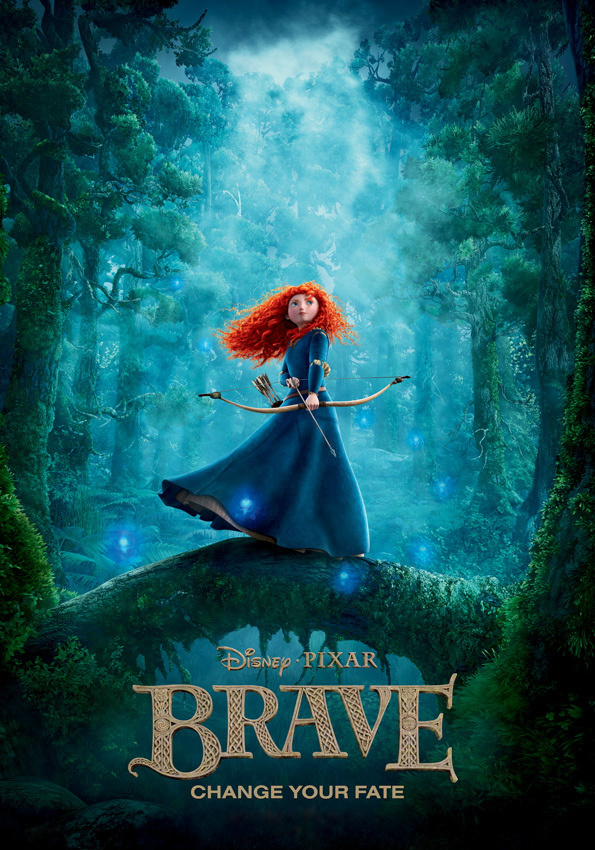
And then there's Brave. I've been interested in this film since I saw the first mysterious teaser trailer. I've loved Pixar since I was a little kid, when my dad took me to see the first Toy Story in theaters. I've been in love with almost every Pixar film since, barring the Cars movies. I sincerely thought that Pixar was pretty much incapable of making a bad film. However, after the critical misfire that was Cars 2, some were worried that the company had lost its touch, myself included. I was hoping that Brave would be a return to form for Pixar, evidenced by the concept they chose to go with. I'd seen what the company could do with superheroes and science fiction, and now they looked like they were ready to tackle epic fantasy, set in Medieval Scotland no less. The fact that this was to be the first Pixar film with a female lead also made this even more interesting. Besides Prometheus and the superhero films, this was the other movie I was hyping up for the summer.
I'm glad to say that I wasn't disappointed. Brave was an all around amazing film, with a well thought out story brimming with action, humor, visual splendor, and plenty of character development. Our hero, Merida, is not only Pixar's first female lead but its first princess as well, making this Pixar's first foray into territory usually covered by its parent company Disney. But unlike Disney, who adapts old fairy tales like Little Mermaid, Beauty and the Beast, Cinderella, and Rapunzel, Brave is an entirely original tale that draws from Scottish lore. In terms of character, Merida blows any regular Disney princess out of the water. She's smart, she's funny, she's wicked with a bow and arrow (Katniss Everdeen and Hawkeye would squirm), and above all she's adventurous, rebellious, and independent. She refuses to tie her fate with that of a man, and therein lies the driving force for the film.
Merida is bound by tradition to marry one of three suitors from rival Scottish clans, less they all go to war. Her mother, Queen Elinor, has been preparing her for this moment her whole life. Not wanting to get married, Merida has a falling out with her mother and runs away, seeking help from a witch who changes Elinor into a bear. The mother-daughter team set out on an adventure to reverse the spell before it becomes permanent, all the while trying to resolve the conflict between the clans and evading the threat of Mor'du, the demon bear who took the leg of Merida's father King Fergus and left him with a lifelong grudge against all bears.
The story itself, while clever, veers into familiar princess fairy tale tropes towards the second half, and is littered with tons of slapstick comedy (even a few partial nude scenes). While this makes the film somewhat predictable, the story is still done rather well, and is carried thanks to the emotional connection that is built up between Merida and her mother. As a consequence, it is this relationship that makes the film soar, and is by far its greatest aspect storywise. Merida instantly regrets what she's done when she sees her mother as a bear, and in the attempt to correct the spell the two grow closer even though Elinor cannot even speak. They gain a newfound appreciation for each other and realize they can learn much from one another, with Merida learning the importance of tradition while Elinor learns it's ok to try new things. Their journey is what audiences will empathize with, and while it's not tear-jerking like the beginning of Up or the end of Toy Story 3, it's still enough to make you care about the characters and their fates.
Visually, this is one of Pixar's best films. The animation captures the beauty and ruggedness of the Scottish highlands perfectly. Castles, lochs, forests, waterfalls, ancient stone monuments, magical will o' the wisps, and demonic bears all look spectacular, not to mention how realistic Merida's wild fiery red hair is. The score is also excellent, peppered with traditional Celtic music that helps set the tone of the film. As an assault on the senses, Brave is just beautiful. So while the story may be a little familiar and therefore not one of Pixar's best, the characterization of Merida along with her relationship with her mother, coupled with the full-blown Scottish setting, make Brave a truly spectacular addition to the Pixar canon. I would highly recommend it to anyone of any age, as this is truly a family film with enough action, story and humor for every one to enjoy. Both Brave and Abe Lincoln were definitely worth seeing, even if for vastly different reasons, and in the end they more than earn their place as wildly entertaining summer films.
Tuesday, June 19, 2012
Top 10 No-Brainer Adaptations (If They're Ever Made)
Today I got to thinking more about the state of the movie industry, and why Hollywood seems so desperate to scoop up any book, comic, or videogame that might make for a good film. There are people (very cynical people, no doubt) who say that there aren't any good ideas left, that all the ideas worth seeing have already been filmed in the century long history of cinema. I am here to say that they're wrong. While I'm as appalled as the next guy about how Hollywood can't seem to come up with anything truly original, if Hollywood is truly looking for great stories to mine into films, I've taken the liberty of compiling a list of what I think are some great works of fiction that, if done right, would make killer movies. I am aware that a lot of these have been in varying stages of development hell to be turned into actual movies, but what amazes me is that, with the amount of genre fare out there, no one has taken a crack at seriously making these films a reality.
10. The Flash- dozens of superheroes have been adapted into film, so why hasn't the Flash been given a go yet? Ok, yes, it's because Warner Brothers has no idea how to properly adapt a superhero unless it's Batman or Superman, but if you're looking for a hero who can serve as an untapped resource in terms of box office potential, the Flash is your man. While Green Lantern was an admirable attempt to introduce another DC hero, with the concept of an epic space opera, it was largely a misfire that failed to set the box office on fire. The Flash can correct that mistake.
In a world of technology that's constantly forcing people to move faster, the Flash can be the epitome of this ideal. Here's a guy who is faster than anyone on the planet, who perceives time and the rest of the world as being slower than he is. A guy who, instead of forcing himself to play catch up with society, must slow down to truly appreciate it. Think Ferris Bueller's famous catchphrase, and the Flash as the living embodiment of it. Add in his status as a forensic scientist (think CSI with superpowers), add in Matrix-style bullet time fight sequences, and the character's trademark wit, and you have a hit movie on your hands.
9. Runaways- Marvel seems to be the king of comic book adaptations right now, so why doesn't Marvel Studios take a chance and adapt the Runaways? There was an arc written by Avengers director Joss Whedon, and the series itself is phenomenal. The series tells of six children who learn that their parents are super villains who are plotting the downfall of humanity, so they run away with their parents' stuff to become super heroes and avenge the wrongs of their families. It's an ingenious concept, with aliens, mutants, crime lords, time travelers, sorcerers, mad scientists, cyborgs, dinosaurs, vampires, gods, and the occasional mainstream superhero thrown into the mix.
The characters feel real, conveying actual teenage angst that doesn't come across as the type of emo-Twilight drivel Hollywood normally feeds us. The action is great, the writing is solid, there's always some humor thrown into the mix, and at the end of the day it comes off as one of the best series Marvel has, if vastly under appreciated. If this doesn't become a movie at some point in the future, then Hollywood is wasting an enormous opportunity to appeal to the teen demographic without talking down to it.
8. Neil Gaiman's The Sandman- Neil Gaiman has emerged within the past few decades as one of THE quintessential sci-fi/fantasy authors. The Sandman, a comic book series published under DC's Vertigo imprint, is considered by many to be one of his greatest works. It relates the tale of Morpheus, aka Dream of the Endless, as he navigates a saga filled with epic fantasy that draws from several mythologies.
One of the few comics to make it onto the New York Times Best Seller list (along with Watchmen and Dark Knight Returns), there was serious talk of making a movie out of the acclaimed series back in the '90s. Several scripts were written, but the project never got off the ground. What a mistake. An amazing series that deals with supernatural and abstract concepts in a novel and sophisticated way, a proper adaptation done with the right budget and casting could be the breakout fantasy hit Hollywood needs in this dark, post-Harry Potter world.
7. Assassin's Creed- Believe it or not, there are several video games out there with enough story to actually encompass a believable film. However, one of the best games that I think is suited to the cinematic format is none other than the Assassin's Creed series. A science fiction/historical epic, a proper Assassin's Creed film would cover the evil Templars as they force former Assassin Desmond into a machine called the Animus, which forces him to relive the genetic memories of his ancestors in various historical eras.
Altair of the Crusades, Ezio of the Renaissance, and Connor of the American Revolution are the protagonists players have stepped into the shoes of throughout the series. This would totally make a kick-ass film series if done correctly, tracing Desmond's different ancestors throughout history as their memories become his in his quest to bring down the Templars and become the ultimate Assassin. The game is already a perfect blend of action, characterization, and story that combines sci-fi with ancient history. Translating it to the screen, if done right, will result in the first film based on a video game that is wholly embraced by gamers and moviegoers alike, all without compromising what made the game so special in the first place.
6. Justice League- This is really a no-brainer when it comes to adapting comic books to film. The Avengers have happened, so now it's the Justice League's time to shine. I know the concept is possible, at least on the small screen. Bruce Timm and Paul Dini's acclaimed Justice League cartoon from the early 2000's is proof enough of that. If WB can bring the same attention to story and character that the cartoon did, a Justice League film could make a killing at the box office, possibly even moreso than the Avengers due to the presence of truly iconic superheroes like Supes, Bats, and Wonder Woman.
Right now it's considered a pipe dream, but then again so was Avengers at one point. Its very existence has proved to the world that the audience loves good comic book movies that stay true to the spirit of the source. If WB locks in someone like Chris Nolan, Geoff Johns or Paul Dini to write and direct, we'll get a solid film that balances action with ample character development for the various Leaguers, making the film feel genuine and not half-assed the way Green Lantern was.
5. Wonder Woman- Yeah, another comic-based property, but considering it's mostly comics that are the well for film ideas these days, it's to be expected. More than any other superhero, I desperately think we need a film for Wonder Woman. Next to Superman and Batman, she's the most iconic hero of the DC pantheon, and definitely the most recognized female crimefighter. To those who say that a female hero can't be interesting or make a good film, they're dead wrong when it comes to Wonder Woman. Her entire origin is rooted in Greek mythology. Her arch enemy is Ares, the Greek God of War. Strip away the invisible plane and modernize the costume to something more Greek-inspired, and we're in business.
The fact of the matter is, Wonder Woman shouldn't even play like a conventional superhero story. It should, essentially, be like a cross between 300 and Clash of the Titans, with the Spartans and demigods replaced by armored supermodels. Wrap your mind around that concept, and tell me it wouldn't be awesome. Marvel has their mythological hero with Thor adapting the Norse myths. Wonder Woman's Greek mythos would be the perfect antithesis to that. We need a good film for her to prove that superhero films with female leads can work just as well as male ones, and that girl heroes can be more than just supporting players or the stars of really bad spin-offs (Supergirl, Catwoman, and Elektra, I'm looking at you).
4. Y: The Last Man- Now THIS is a comic book worth adapting. I came across Y: The Last Man very recently, but the series has completely blown me away. The very idea of the series has so much appeal to a wide variety of demographics that film studios would be foolish to pass this up. Picture if you will, a world where there are no men, only women. All mammals with a Y chromosome are wiped out by a mysterious plague, and females are given free reign over the Earth. Now imagine that one man, and his pet monkey, were the lone survivors, and had to trek through this new world to ensure the survival of the human race. It's an ingenious concept.
Women would pay to see how the world would change if they were in charge, and men would relate to the last man, Yorrick Brown, a hilarious everyman who suddenly finds himself the most valued person on Earth as the world's most eligible (and only) bachelor. The story and characters are so realistic that filmmakers wouldn't have to change much from the comic. The premise is so cinematic in and of itself that adapting it will be a piece of cake. The only challenge would be how to condense the 60 issue story into a more manageable run time. If it were up to me, I'd either go the Lord of the Rings route for film or the Walking Dead route for TV-make it as a nine hour long film split into a trilogy, or a serialized TV show that can adapt an issue per episode. Either way, this series just screams for an adaptation, and I sincerely hope it gets around to being made.
3. Halo- Hollywood, could it really be any more simple? Halo is the most iconic video game series of the last decade. It has its own heavily crafted mythology, filled with memorable characters like Captain Keys, the AI Cortana, and of course Spartan 117 himself, the Master Chief. It has veritable threats including the various alien races of the Covenant, the zombie-like parasitic Flood, and the leftover ringworld technology of the Forerunners. The main series already has an arc that, with a little simplification, can be translated to film very easily.
Worried about Chief having enough character or ruining him by taking his helmet off? Put the emphasis on Cortana, or at least a core squad of Marines or ODST's, as your POV characters so the audience can connect with them. Adapt Halo: Reach first then segue into a second film based entirely on the first game, followed by a final film that adapts 2 and 3 together. If it's done correctly, Halo could be as epic as Lord of the Rings, only, you know, in space. In fact, it could even be a next generation Star Wars. The potential is there, Hollywood. Get on it immediately.
2. Uncharted: Drake's Fortune- In terms of video game adaptations, if Halo can be the next Star Wars, then Uncharted can be the next Indiana Jones. The games, which follow the globetrotting adventures of treasure hunter Nathan Drake, are already praised for essentially being playable films. They're that cinematic. If that's truly the case, making them into actual films should be relatively simple. If done right, Uncharted can be the modern-day Indiana Jones film we all wanted Crystal Skull to be. It's one of those games that has so much attention poured into making believable characters and a realistic story that film studios would be complete idiots to not consider making this a high grade film franchise.
1. Pendragon: Journal of an Adventure Through Time and Space- This is my absolute number one choice for a work of fiction that has yet to be adapted into film, simply because it completely baffles me that no one has even considered it. All of the other works that I have mentioned have, at the very least, been talked about for film or TV adaptations. What frustrates me is that this series has not. Harry Potter, Twilight, and more recently the Hunger Games have made me see the potential young adult book series have to become box office juggernauts. NEVER underestimate the power of a loyal fanbase of teen readers. Pendragon has quite the fan following, myself included. It may not be as large as Potter, Twilight, or the Games, but it's large enough to create a built-in audience. I mean, if books like Percy Jackson, Eragon, The Golden Compass, or even I Am Number Four can be auctioned for films, then surely Pendragon has a shot, right?
The series tells the tale of a teen named Bobby Pendragon, who discovers that he is part of an elite team of warriors called Travelers, gifted with special abilities, who make use of portals called Flumes to travel to different dimensions, called Territories, in order to save them from being corrupted by an evil shape shifting demon called Saint Dane. He is whisked away to a multitude of worlds, including an underwater world, a jungle world occupied by humanoid cat people, a decaying world where people live inside a virtual reality, and even three seperate time frames for Earth, including one during the Great Depression and an era thousands of years in the future. He writes down his adventures in journals and sends them home to his best friends, Mark Dimond and Courtney Chetwynde, who go from observers to active participants in Bobby's travels as the series progresses. Like Harry Potter and Hunger Games, it's a coming of age tale, one that ingeniously incorporates riveting action, genuine pathos, and engrossing sci-fi/fantasy elements into a complex narrative that gets better with each book.
From the moment I started reading this ten-book series, I knew that it would make for a perfect set of films. With today's technology, we have the capabilities to bring the territories of Halla to life, both the unique worlds and the extraordinary peoples who occupy them. If you thought Avatar immersed you in the environment and culture of an alien world, you haven't seen anything yet. With the right cast, script and director, not to mention a hefty budget, this could be the next box office juggernaut, powerful enough to eclipse Potter, Twilight, and Hunger Games. I want this series to be a set of films, or at the very least an ambitious TV miniseries, within my lifetime, or my continuously wavering faith in Hollywood will be completely lost.
Saturday, June 9, 2012
Prometheus Review
It's been a while since I last saw any film associated with the Alien franchise on the silver screen. I recall having seen the second AvP movie back in winter of 2007, at the time loving it, then developing something called taste when I saw the brilliance that was the first two Alien flicks. When it was announced that Ridley Scott, the director of the first Alien along with Blade Runner, was returning to the genre that he helped define by making an Alien prequel, I was at first skeptical then pumped. However, I was a little confused when Scott announced his film wouldn't be a direct prequel, but instead have "Alien DNA", as he put it. Now that "Prometheus", this so-called prequel to Alien, is finally out, how good is it? Is Prometheus actually tied into Alien? Does it work better as a prequel or a standalone story, which Scott clearly wanted due to his attempts to distance this film from the Alien series?
In all honesty, Prometheus is connected to the Alien series and for all intents and purposes is a prequel, but the connections to Alien are only there for those who wish to point them out. For people who grew up not watching any of the alien films, Prometheus comes off as an imaginative standalone sci-fi/horror story complete with amazing visuals, genuine scares, and even philosophical questions to boot.
Scott has assembled a top-notch cast here, with Noomi Rapace as Dr. Elizabeth Shaw, Logan Marshall-Green as her boyfriend Charlie Holloway, Idris Elba as the ship Prometheus's captain, Charlize Theron as corporate agent Meredith Vickers, Guy Pearce as Weyland Corp CEO Peter Weyland, and Michael Fassbender as the android David. All of the cast members give off great performances, but I have to give specific praise to Rapace and Fassbender especially for their characters.
Rapace's Shaw is no Ripley, but luckily she doesn't need to be. She's a scientist, albeit one still convinced that there is a God. She is seen throughout the entire film wearing and treasuring a cross that belonged to her father, and still convinced God exists even if her discoveries point to humanity's creation at the hands of alien beings. Her steadfast conviction to hold onto her beliefs is admirable, and is conveyed brilliantly by Rapace. Not only that, but she certainly holds her own during scenes of action and terror, particularly in a scene where she is forced to surgically remove an alien parasite from her own abdomen. However, Rapace pales in comparison to the film's most compelling character, who is by far Fassbender's android David.
David is interesting, to say the least, mainly due to his childlike innocence. His performance stood out to me the most. He reminded me a lot of the HAL 9000 from 2001, in that he was an A.I. simply created to fulfill a mission and puts others in danger to carry it out. He has no feelings, yet hopes to model himself after humanity, and clearly tries to understand it. The beginning of the film has him watching clips from Lawrence of Arabia, and modeling himself after Peter O' Toole both in looks and mannerisms. Another scene where he finds the Engineers' star map and gazes at it in childlike wonder speaks volumes of his attempt to comprehend the world around him.
But what of the plot? The plot is both the film's strength and its greatest weakness, as there are times when the film doesn't seem to make up its mind as to what it wants to be. Does it want to be a straight up horror story, modeled after the original Alien? Does it want to have its characters blasting at alien creatures while fighting for their survival, like in Aliens? Does it want to explore deep philosophical questions about the nature of God and creation, kind of like in Blade Runner or 2001? The film goes for a little bit of all three, and while it was interesting to see these themes come together, the film would have done better to pick a central premise and stick with it, instead of coming off as wanting to be intelligent the first half and then abandoning this premise for scares in the second half.
The basic plot involves the scientists of the ship Prometheus discovering evidence that a race of alien beings called Engineers created life on Earth, and head there to meet them only to discover that they intend to utilize a black mutagen they created to wipe out humanity. The mutagen mutates creatures it comes into contact with while killing those who ingest it. It is never stated exactly why the Engineers suddenly changed their minds about us, their creation. Why did they want to exterminate us? Did we do something wrong?
Personally, I'd like to think that it was all a big experiment to them. The running motif throughout the film deals with creation and destruction, God and man, man and A.I., parents and children. When David asks Holloway why man created robots, Holloway replies "because we could". Therein, I think, lies the motivation of the Engineers. They had the means to create life, so they did. A suicidal Engineer on ancient Earth did what he did so his race could see a new species grow, one which they could then influence. But then, once that species had grown to a specific point, they created the mutagen to wipe us out, just because they could, and maybe because they wanted to ensure that their "children" did not become a threat. Allusions are even made to the original Prometheus myth, implying that the gift of fire is creating life, and that by manufacturing artificial life in David, humans (as Prometheus) invoked the wrath of the Engineers (the gods), who seek to punish us by destroying us. At least, that's my theory.
The fact that I didn't even come out of this film with a lot of answers, just theories, speaks volumes as to why I enjoyed this film, despite its flaws. The film doesn't resolve any of the big questions it raises, which may piss off some viewers wondering how everything is resolved and how it directly ties into Alien. But that's the joy of the film. When dealing with questions of "does God exist?" or "why are we here?", we're never going to get straight answers. The film raises them, and even implies solutions, but it's all guesswork. The audience can either infer answers for themselves, or wait until a sequel is made to get more direct answers (the film does set up for one).
I'm not going to lie here, though: the end of the film does reveal that, given enough hosts to gestate in, the black liquid creates a creature that resembles the original Alien. And yes, the Engineers here are the species the Space Jockey hails from in the original film. However, this is an entirely different planet, and the one Engineer is not the one encountered in the first film. Like I said, the film only makes references to the original Alien. It is not a straight up prequel that bends over backwards to stuff in cameos to create connections, the way the Star Wars prequels did. For all intents and purposes, Prometheus is it's own beast, just as Ridley Scott intended, but it does exist in the Alien universe and does reveal the origins of the Xenomorphs, even though the point of the film is to raise more questions than it answers.
The fact that we even have a science fiction film that wants to raise these questions, and spark philosophical debates among filmgoers, makes this film unique. Going in expecting this to be a full blown Alien prequel will warrant disappointment. But viewing it as a sci-fi/horror story with ambitious questions makes this a damn good movie, one of the best science fiction films I've seen in quite a while. If you want to compare it to the first few Alien films, fine, it's not as good, but it's far beyond Alien 3, Ressurection, and the AvP films. But like I said, don't compare this film to them. The references are there, but this film works best by viewing it as related to the Alien series instead of being a direct part of it.
In the end, I'd highly recommend this film to any die hard science fiction fans who are impressed by stunning visuals, impressive characterization, genuine scares, and intelligent questions about human nature. Speaking of visuals, the ones in this film are absolutely breathtaking, with H.R. Giger's work being as great as in the other Alien movies and several wide shots of the alien planet being just gorgeous. In the end, Prometheus was definitely worth watching, whether you are familiar with the Alien films or not, and it more than earns a spot as one of the best films of the summer season.
Tuesday, May 29, 2012
Triple Review: Three Stooges, The Dictator, Men in Black 3
As far as film criticism goes, it's not easy to review the comedy genre. Everyone has different tastes when it comes to comedy. Some prefer their comedy films to have actual characters, with the humor deriving from the bizarre situations they end up in. Some like films that have next to no character development and thrive off of gross out humor. When I think of some of the best comedy films of all time, films like "Animal House", "Ghostbusters", "Dr. Strangeglove", "Airplane", "The Blues Brothers", "Monty Python and the Holy Grail", and "Blazing Saddles" immediately spring to mind. While I wouldn't consider them comedy classics, I also get a kick out of some modern day comedy films, such as the "Austin Powers" trilogy, "The Hangover", "Tropic Thunder", "Zombieland", and "Anchorman". These films, to me, represent my own taste in comedy.
While I consider myself an analytical film reviewer with very specific tastes depending on the genre, I guess my only real prerequisite for a comedy film is if it makes me laugh. It doesn't have to make me laugh out loud, per se, but it should be funny enough to consistently make me laugh. A film with only a couple of good jokes doesn't entertain me as much as one that gets me laughing and smiling throughout its entire run time. Since comedy is always left to the viewer, I consider it inherently wrong to review a comedy film as if it's Oscar worthy material.
Now true, if a film's humor is entirely built around gross out jokes and celebrity gags (cough cough the Parody Movies cough cough) then that doesn't fly with me, but I can forgive a film if it succeeds in making me laugh without also making me feel stupid. And even then, I have my moments of weakness where I laugh knowing full well that what I'm seeing is idiotic. So, with all that said, I found myself over the last two months watching three distinct comedy films in theaters, one a couple of weeks ago and two very recently. With my own thoughts on what I view as a decent comedy film out of the way, how would I then classify "The Three Stooges", "The Dictator", and "Men in Black 3"?
I'm going to be frank when I say I never grew up watching the Three Stooges. Maybe I'm the victim of a very sheltered life, but I never got into them. Years later I saw old reruns on TV, and I did laugh at their wily shenanigans, but I can't rightly say that going into this movie I felt a sense of nostalgia, the way my friend did when he asked me to go see it with him. But, suffice to say, this cinematic adaptation of the classic shorts has a lot of love and respect for its source material. The three actors they got to portray the stooges do a wonderful job of channeling the performances of their predecessors. After adding their costumes, they are dead ringers for the stooges of old. The film is even set up in a three act structure the same way the old shorts were.
However, despite the multiple homages to the classic Stooges, the film ultimately plays more like a tribute that tries to be funny rather than actually being funny. The slapstick gags get old after a while, and only a few of them are ever truly inspired. While yes, it did make me laugh, I would consider this more of a love letter to fans of the Stooges than a solid comedy film that tries to attract new viewers. Somehow I don't think a modern day audience would perceive the Stooges' slapstick as funny, even though their routine was an inspiration to comedians everywhere back in the day. Overall, this was a great homage to the old Three Stooges that unfortunately is an average comedy flick with hit or miss jokes. Still, any Stooges fan should check it out if they did grow up watching the original shorts, if only for the nostalgia.
The next film, "The Dictator", is the latest film from Sacha Baren Cohen, the man behind "Borat" and "Bruno". Truth be told, I've never seen either of those films, but I am told that "Borat" is hilarious while "Bruno" falls flat. Maybe it's better that I haven't seen those movies, because it allows me to view "The Dictator" on its own without comparing it to Cohen's other characters. What I can say about this film is that, at least in my opinion, it's a pretty damn good comedy, even if a lot of the jokes are wildly offensive to women, various ethnic groups, Middle Eastern countries, and various governments.
A film like this could not have been made ten years ago, in the immediate aftermath of 9/11. Only now is it acceptable to make a film that completely parodies the life of a Middle Eastern dictator. For what it's worth, Cohen makes it work. His character, General Aladeen, comes off as your stereotypical madman with a sympathetic side, which is made more apparent when he's stripped of his power and becomes a commoner in America. Some of the jokes don't make much sense, but they are still funny, some even downright hilarious. I wouldn't go calling it a masterful comedy, as even the obvious socio-political commentary is handled pretty weakly, but it's still a fun watch, and definitely worth a rental.
Now comes the film I had my most recent outing at the theater with, one that I have been looking forward to for ten years without even realizing it. Unlike the last two films, I definitely have a history with this one. "Men in Black 3" was a sequel I thought would never happen. I was ten years old when I saw the first two "Men in Black" films, and at the time I found them both hilarious (even if the second one has soured in my mind with the years). Before I go anywhere else, yes, I realize that these films do cross over into the action/sci-fi genres, but at their heart, the Men in Black films are definitely comedies. People don't just go to see agents blowing up aliens; they go to see Will Smith and Tommy Lee Jones blow up aliens, all the while riffing on each other. It's a comedy duo that works to perfection, and even at their lowest point in MIB II, Smith and Jones create a comedic chemistry that can't be ignored.
So, what of the new film? Long story short, MIB III is both hilarious and at the same time charming and emotional, a better follow up than MIB II that is a notch below the first but is still effective as both a sci-fi and as a comedy. I was at first weary when the film was announced as having a time travel plot, along with the revelation that Tommy Lee Jones was going to be replaced for the majority of the film with a younger version played by Josh Brolin. Luckily, Brolin's Jones impression is so utterly perfect that I honestly thought that the filmmakers just de-aged Jones with computer effects. That's how seamlessly Brolin fits into his role. When the Smith/Jones shtick started to get old in MIB II, this film made it come alive again. It has a great set-up with a scary new villain, Boris the Animal, escaping from prison to kill Agent K in the past so his actions won't prevent Boris's race from invading Earth. While this is happening, Smith's Agent J is lamenting how cold and indifferent his partner has become, which not only shows how important K is to J but also provides a great contrast once we meet the younger K of the '60s.
The time travel plot is handled a lot more intelligently than I previously believed. While there are several points where the characters' actions would open up a whole can of paradoxes, a lot of these threads are resolved by the introduction of Griffin, a hyper dimensional alien who can perceive multiple timelines at once. Through him, we learn of the different timelines that converge and are made possible through time travel, ones in which Agent K both lives and dies. Not only is this a clever way to introduce the confusing concept of time paradoxes, but Griffin himself is a hilarious character that heightens the comedic aspect of the film. He has a loving innocence to him, but talks extremely fast and is constantly worried over which possible futures will end up happening.
Will Smith, I have to say, is better than ever as Agent J. He fits back into the role he played ten years previously like a glove, and bounces off Brolin just as well as he does Jones. Seeing the two together provides some great comedy. Of special note is J's reaction to both the altered present and the '60s environment, as he begins freaking out about the situation in a way only Will Smith can do. Jemaine Clement's Boris character comes off as a convincing threat, with an awesome character design (his entire body is made of tiny claws that can open up and fire bony spikes at people). A scene where he interacts with his younger self is legitimately terrifying, but also hilarious in that they have a kind of rivalry going on (the younger Boris refuses to believe that he will make the same mistakes as his future self, and the older Boris reprimands him for it). But, what I really like about this film, as both a sci-fi and as a comedy, is the '60s setting.
This is where I'm legitimately glad the filmmakers went with the time travel plot, other than to see J interacting with young K. The entire MIB franchise is given a new sense of life through the '60s nostalgia. The MIB headquarters is vastly different; female agents sit at typewriters, neuralyzers and jet packs are giant hulking machines that take up vast amounts of power, and the aliens have wackier designs to reflect the retro '60s B-movie look. It's a very fun world to play around in, and seeing the filmmakers make jabs at '60s culture is a real treat. While I'm not sure if the Men in Black needed a third installment, especially one focused on time travel, I was pleasantly surprised at how good this turned out. While it does still suffer from plot holes due to paradoxes, this is something inherent in all time travel films. The ending has a surprise twist that adds a bit of emotion to the film, one which deepens the friendship between J and K and makes their characters better for it. Ultimately, I had a great time at the theater watching this film and laughed at the jokes throughout, so I would definitely say MIB 3's role as an effective comedy film has been fulfilled.
"Three Stooges", "The Dictator", and "Men in Black 3" all have their ups and downs as far as comedies go, but I still had a fun time watching all three of them, some more than others. Men in Black was by far my favorite out of these three, not so much because of the nostalgia factor but because it had a better understanding of when to balance its characters and story with jokes that were actually funny. Dictator's jokes were more gross out gags that tried to be relevant by adding a socio-political context, and Three Stooges was pure slapstick that was banking on the nostalgia factor of its source. While films like that do have their place, and I did enjoy both of them to varying degrees for what they were, MIB 3 worked better as a comedy for me for the reasons I stated above. Not only do I like comedy films that make me laugh throughout, I like it when they make an attempt to build a story and unique characters into the narrative, so the humor is more meaningful when I care about the characters and the situations they end up in. Seeing these three films in theaters has helped me reflect on that, and made it more apparent now that I have actually reviewed them.
Subscribe to:
Posts (Atom)